How Much Does a Shopify Theme Cost? A Complete Pricing Guide
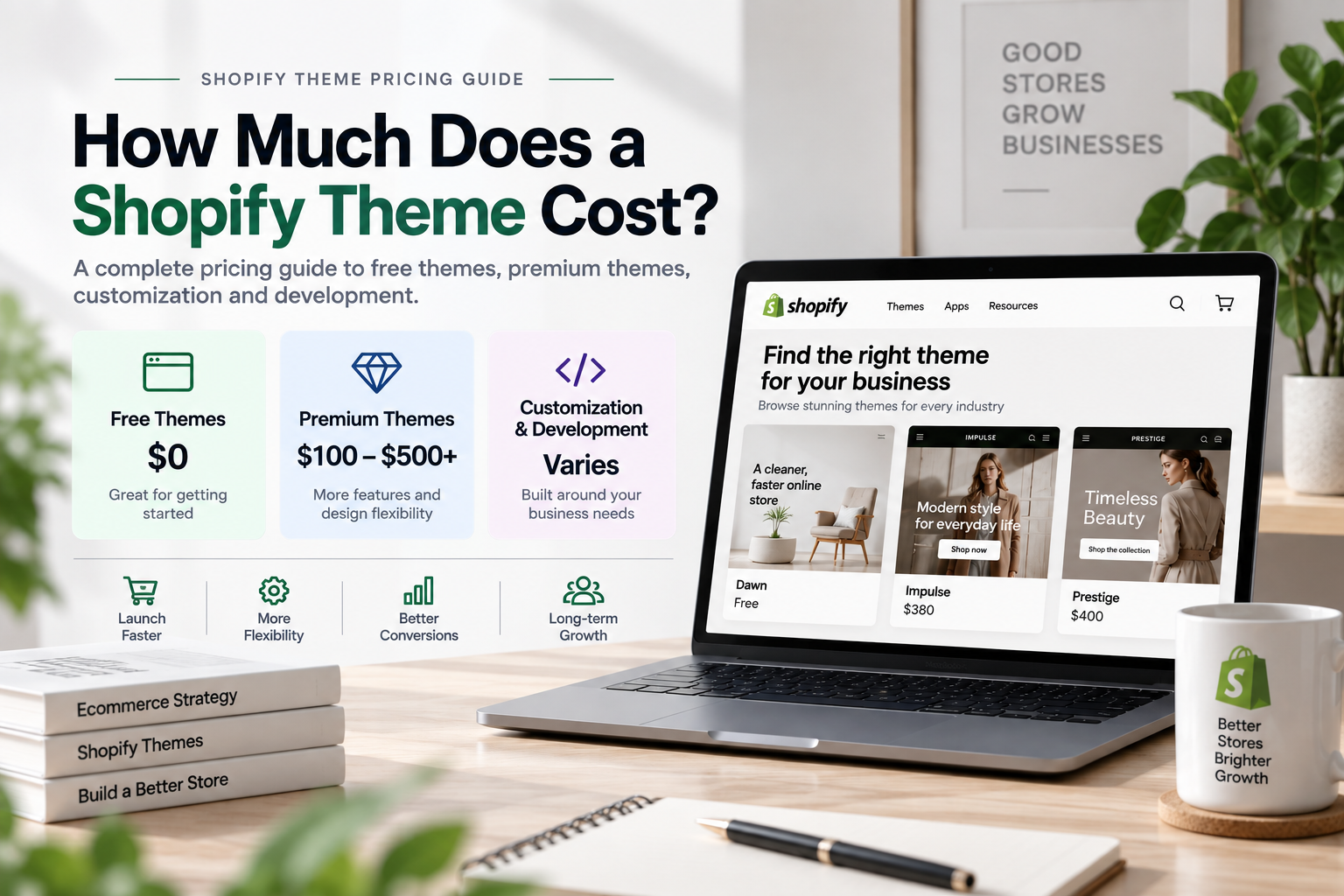
A Shopify theme can cost anywhere from $0 to several hundred dollars, depending on the type of theme, its features, and how much customization your store requires.
At the simplest end, Shopify offers free themes that provide the essential functionality needed to launch an online store. At the other end, premium themes can cost hundreds of dollars and offer more advanced layouts, customization options, product presentation tools, and built-in ecommerce features.
But the theme price itself is only one part of the budget.
If you need custom sections, design changes, performance optimization, third-party integrations, or custom Shopify development, your total investment can be significantly higher than the theme license alone.
So, how much should you actually budget for a Shopify theme?
Let’s break down the different costs.
Table of contents
- Shopify Theme Pricing at a Glance
- Are Shopify Themes Free?
- How Much Do Premium Shopify Themes Cost?
- Is a Shopify Theme a One-Time Cost?
- What Does a Shopify Theme Actually Include?
- Free vs Premium Shopify Theme Cost
- How Much Does Shopify Theme Customization Cost?
- What Affects Shopify Theme Customization Cost?
- How Much Does Custom Shopify Development Cost?
- The Hidden Costs of a Cheap Shopify Theme
- Shopify Theme Cost vs App Costs
- Does a More Expensive Shopify Theme Mean a Better Theme?
- How Much Should You Budget for a Shopify Store Theme?
- What Should You Look for When Comparing Theme Prices?
- How to Reduce Your Shopify Theme Cost
- When Should You Invest in Custom Shopify Development?
- Premium Theme + Custom Development: A Practical Middle Ground
- How Much Does a Shopify Theme Cost in the Long Run?
- Is a Shopify Theme Worth Paying For?
- What About Shopify Theme Licensing?
- Common Mistakes When Budgeting for a Shopify Theme
- Shopify Theme Cost: What Should You Actually Spend?
- Final Thoughts
Shopify Theme Pricing at a Glance
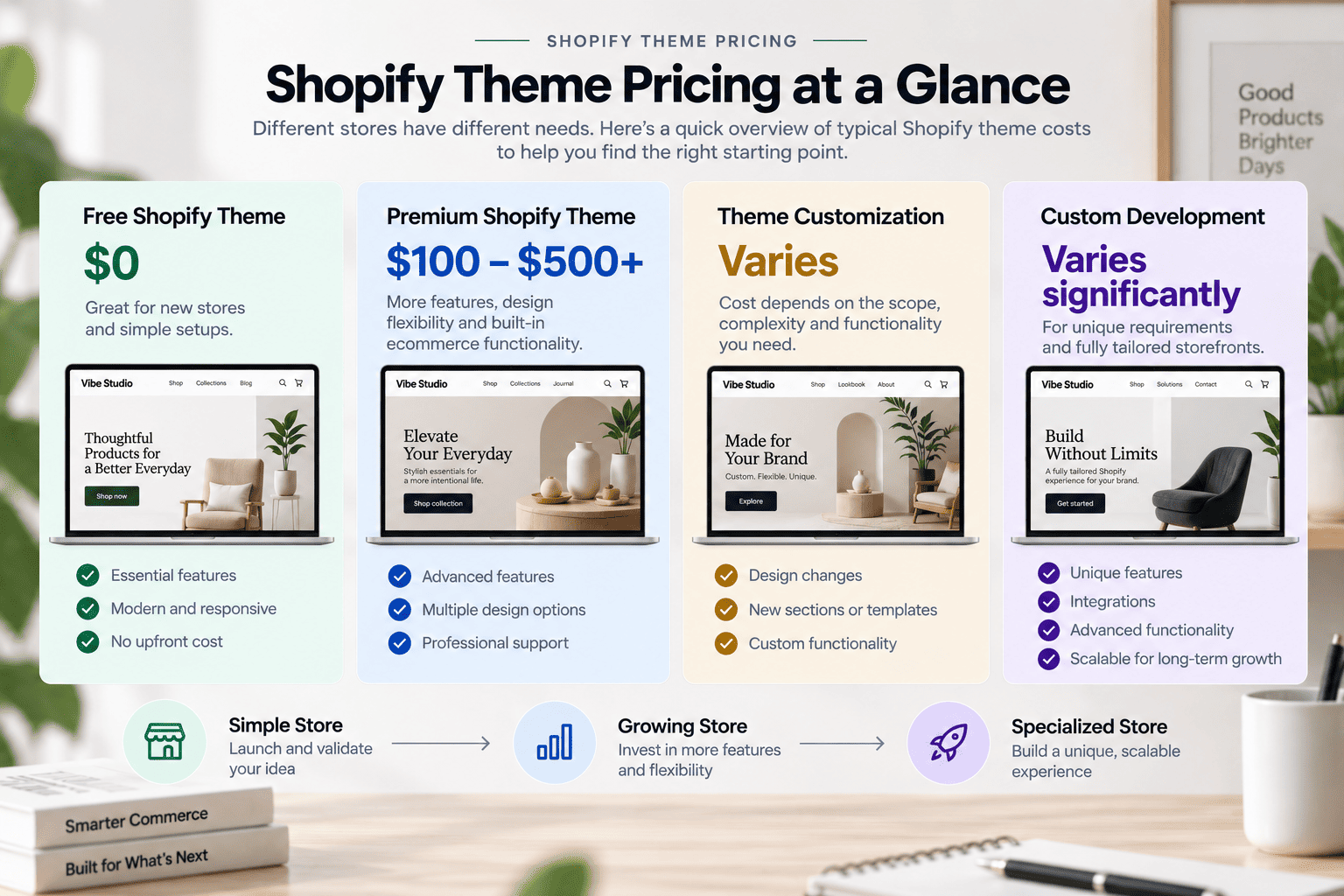
The easiest way to understand Shopify theme cost is to divide themes into three categories:
| Theme type | Typical theme cost | Best for |
|---|---|---|
| Free Shopify theme | $0 | New stores and simple requirements |
| Premium Shopify theme | Around $100–$500+ | Growing brands and stores needing more features |
| Custom theme development | Varies significantly | Businesses with unique requirements |
The Shopify Theme Store currently includes both free and paid themes. At the time of writing, Shopify lists dozens of free themes and more than 1,200 paid themes, with current paid examples ranging from around $100 to $500.
These prices can change as theme developers release new versions or update their pricing, so treat them as a practical market range rather than a permanent price list.
It is also important to distinguish the theme cost from the cost of running a Shopify store. Your Shopify subscription, domain, apps, payment processing, and development work are separate expenses.
Are Shopify Themes Free?
Yes.
Shopify provides a collection of free themes that can be added to a store without purchasing a theme license. Shopify’s free theme collection includes options such as Dawn, Craft, Sense, Refresh, Studio, Trade, and Horizon.
Free themes are particularly useful when:
- You are launching your first store
- Your catalog is relatively simple
- You have a limited initial budget
- You are comfortable with the standard Shopify shopping experience
- You do not need highly specialized functionality
- You want to validate your business before investing heavily in design
A free theme does not mean you have to build a basic-looking store.
You can still customize colors, typography, imagery, sections, products, navigation, and other theme settings.
The main difference is that you generally start with a smaller feature set and fewer specialized design options than many premium themes.
How Much Do Premium Shopify Themes Cost?
Premium Shopify themes typically cost a few hundred dollars, although the actual price varies considerably between themes.
Current examples in the Shopify Theme Store include themes priced around $150, $180, $220, $250, $300, $350, $400, $420, and $500.
For example, Shopify’s current Theme Store listings include paid themes such as Xtra at $150, Ormonte at $180, Swift at $220, Helix at $250, Prestige at $400, and Impulse at $500.
This makes a range of roughly $150–$500 a useful planning range for many premium themes, although themes outside this range may also exist.
Premium themes often include more sophisticated layouts and features such as:
- Advanced product filtering
- Mega menus
- Quick view
- Quick add
- Product recommendations
- Color swatches
- Promotional sections
- Advanced product media
- Customizable collection layouts
- More theme settings
- Multiple design presets
- Enhanced mobile experiences
For a deeper look at what you get for your money, read our guide to Premium Shopify Themes: Features, Benefits, and How to Choose One.
Is a Shopify Theme a One-Time Cost?
A theme purchased through the Shopify Theme Store is treated as a one-time charge, rather than a recurring monthly theme subscription. Shopify’s billing documentation lists theme purchases among one-time charges.
However, there is an important distinction between paying for a theme and paying for everything required to maintain your storefront.
Your overall Shopify budget may include:
- Shopify subscription
- Theme purchase
- Domain
- Apps
- Custom development
- Design work
- Photography
- Copywriting
- SEO
- Third-party services
So a $300 theme does not mean your entire store will cost $300.
The theme is simply one component of the overall ecommerce investment.
What Does a Shopify Theme Actually Include?
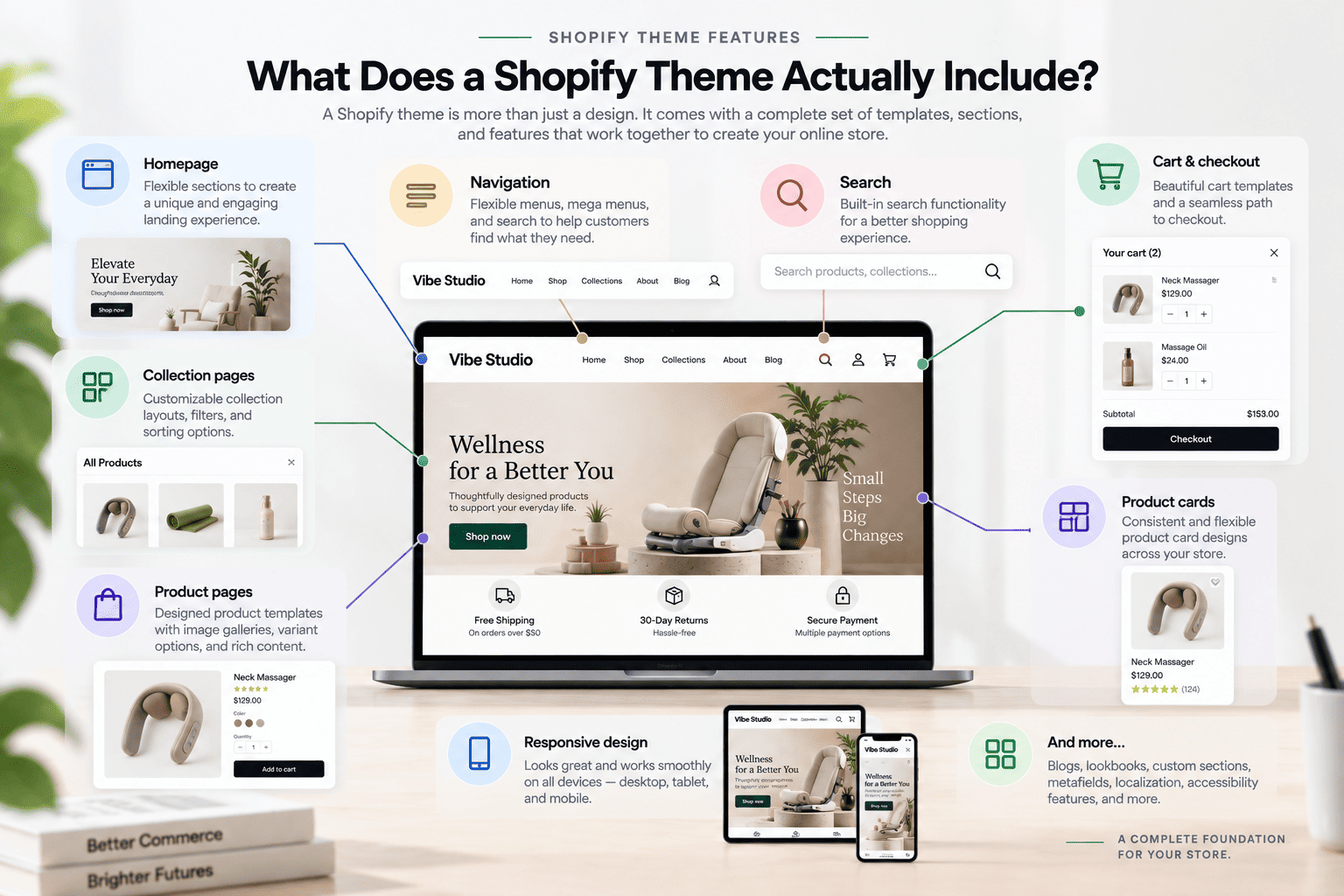
Before comparing prices, it is worth understanding what you are actually buying.
A theme provides the storefront framework that controls how your store looks and behaves.
Depending on the theme, this can include:
Store Layouts
Themes typically provide templates and sections for areas such as:
- Homepage
- Product pages
- Collection pages
- Cart
- Search
- Blog
- Pages
- Navigation
Theme Settings
A modern Shopify theme may allow you to control:
- Colors
- Typography
- Spacing
- Buttons
- Product cards
- Images
- Layouts
- Header and footer
- Promotional sections
Ecommerce Features
Many premium themes also include functionality such as:
- Quick add
- Quick view
- Product recommendations
- Product filtering
- Color swatches
- Mega menus
- Sticky navigation
- Promotional banners
- Cart drawers
Shopify itself describes its Theme Store as offering themes with commerce-focused features, essential ecommerce functionality, and developer support and updates.
This is why comparing themes purely by price can be misleading.
A $200 theme with the features you need may ultimately be more economical than a $100 theme that requires several additional customizations or apps.
Free vs Premium Shopify Theme Cost
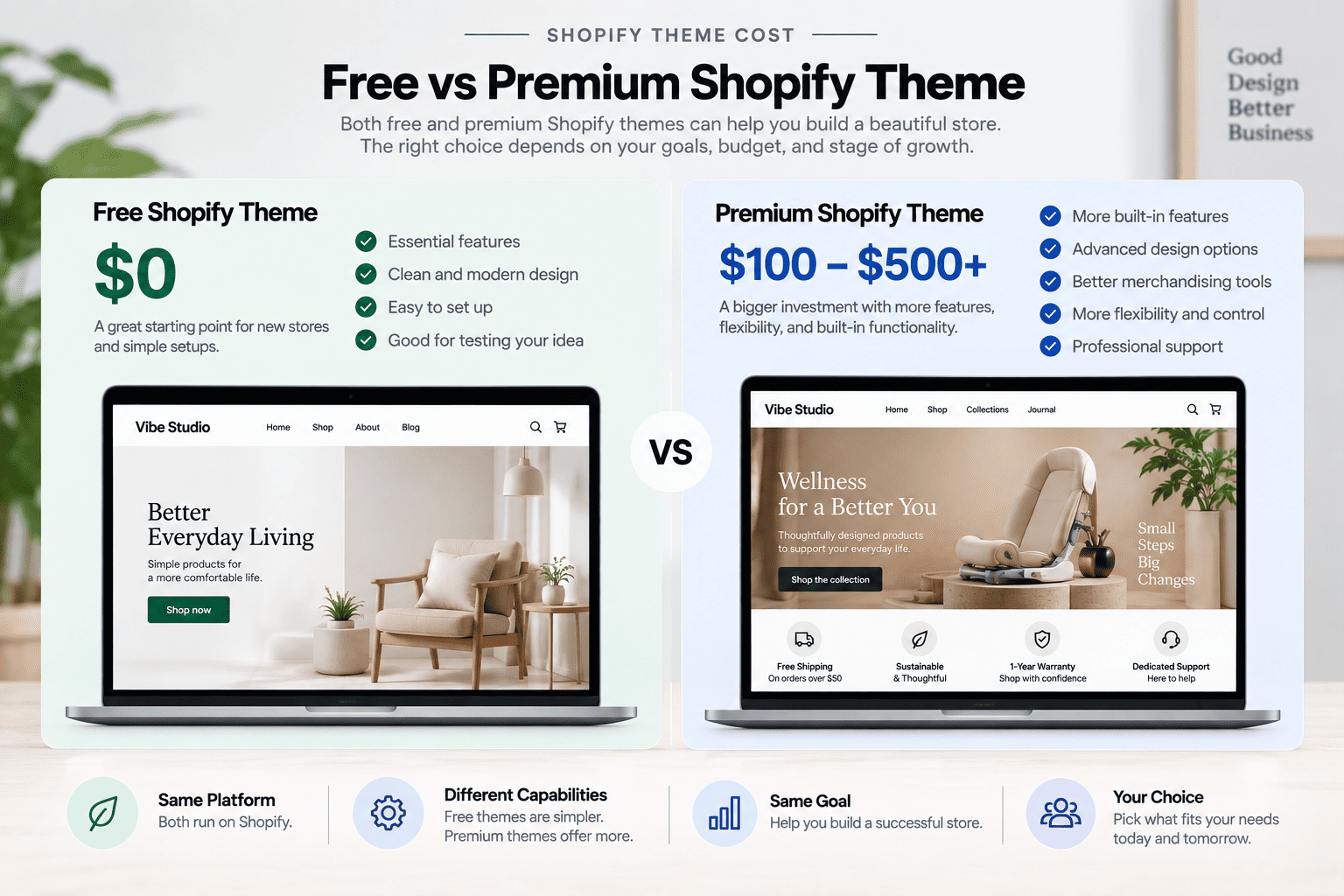
The biggest difference between free and premium themes is not simply the price.
It is the amount of flexibility and functionality you get before needing additional work.
| Factor | Free Theme | Premium Theme |
|---|---|---|
| Theme cost | $0 | Usually $150–$500+ |
| Basic ecommerce | Yes | Yes |
| Customization | Good | Usually more extensive |
| Advanced layouts | Limited | More options |
| Product presentation | Basic to advanced | Often more advanced |
| Built-in features | Essential | More extensive |
| Support | Shopify/community depending on theme | Usually developer support |
| Updates | Yes | Yes, from developer |
| Custom development needed | Potentially more | Potentially less |
Neither option is automatically better.
If a free theme already provides everything your store needs, spending $400 on a premium theme may not create meaningful value.
On the other hand, if a premium theme eliminates the need for several custom features or apps, the additional theme cost can be worthwhile.
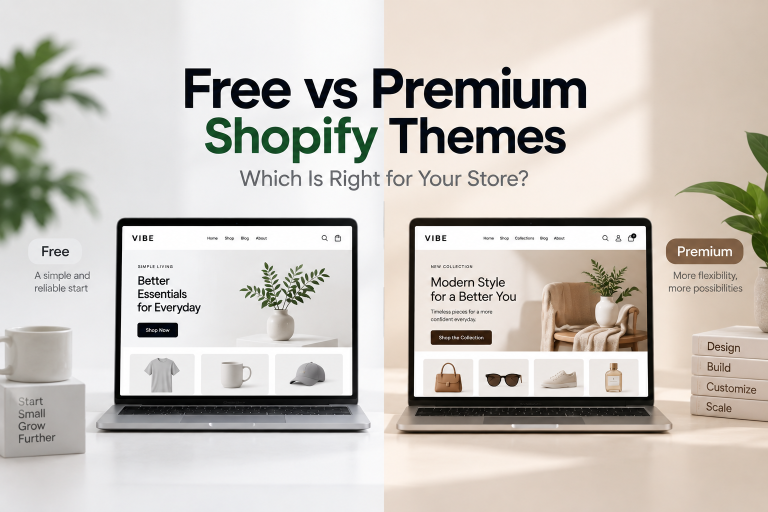
For a more detailed comparison, see our guide to Free vs Premium Shopify Themes: Which Is Right for Your Store?.
How Much Does Shopify Theme Customization Cost?
This is where Shopify theme budgeting becomes less straightforward.
You may purchase a theme for $300 and still need another $500, $1,500, or more in development work depending on what you want to change.
Simple customization may include:
- Changing colors
- Adjusting typography
- Editing spacing
- Configuring existing sections
- Replacing images
- Rearranging existing content
These changes can often be handled directly through the Shopify theme editor.
More advanced customization may involve:
- Custom Liquid
- New sections
- New templates
- JavaScript interactions
- Custom product components
- Advanced filtering
- Custom cart functionality
- API integrations
- Metaobjects
- Performance optimization
At that point, you are no longer simply configuring the theme.
You are investing in development.
What Affects Shopify Theme Customization Cost?
The cost of customization depends on several factors.
Design Complexity
A simple layout adjustment takes less time than building a completely new interactive section.
Number of Templates
Customizing one product template is very different from creating custom layouts for products, collections, pages, blogs, and landing pages.
Functionality
A visual change is usually simpler than implementing custom business logic.
For example, changing the color of a button is straightforward.
Creating a product configurator that changes available options dynamically is a much larger development project.
Integrations
Connecting Shopify with external systems can increase development complexity.
Examples include:
- ERP
- CRM
- Email marketing
- Inventory systems
- Store locator platforms
- Custom APIs
- Product information systems
Performance Requirements
If your customization includes JavaScript-heavy interactions, third-party scripts, or dynamic content, additional performance work may be required.
This is particularly important for stores that are targeting strong Core Web Vitals.
How Much Does Custom Shopify Development Cost?
There is no single fixed price for custom Shopify development because the scope can vary dramatically.
A small development task may involve a single custom section or component.
A larger project might involve:
- Custom theme architecture
- Multiple custom templates
- Advanced product functionality
- Custom customer journeys
- External API integrations
- Performance optimization
- Complex business logic
- Extensive testing
The best way to think about the cost is in terms of project scope rather than theme price.
For example:
Theme purchase
$0–$500+
Customization
Additional development based on requirements
Custom functionality
Additional development based on complexity
Apps and services
Additional recurring or usage-based costs
This is why two stores using the same $300 theme can have completely different total development budgets.
If your requirements go beyond what a theme can reasonably provide, our guide to Custom Shopify Development: Build a Store Around Your Business explains when custom development makes sense.
The Hidden Costs of a Cheap Shopify Theme
A low theme price does not always mean a low total cost.
Imagine two themes:
Theme A: $100
Theme B: $350
Theme A looks cheaper.
But suppose Theme A requires:
- Custom product filtering
- Additional navigation development
- A custom product section
- Additional app functionality
- More developer work
Theme B already includes most of those features.
The $250 difference in theme price may become insignificant compared with the additional development required for Theme A.
This is why you should evaluate total cost of ownership, not just the theme’s sticker price.
Shopify Theme Cost vs App Costs
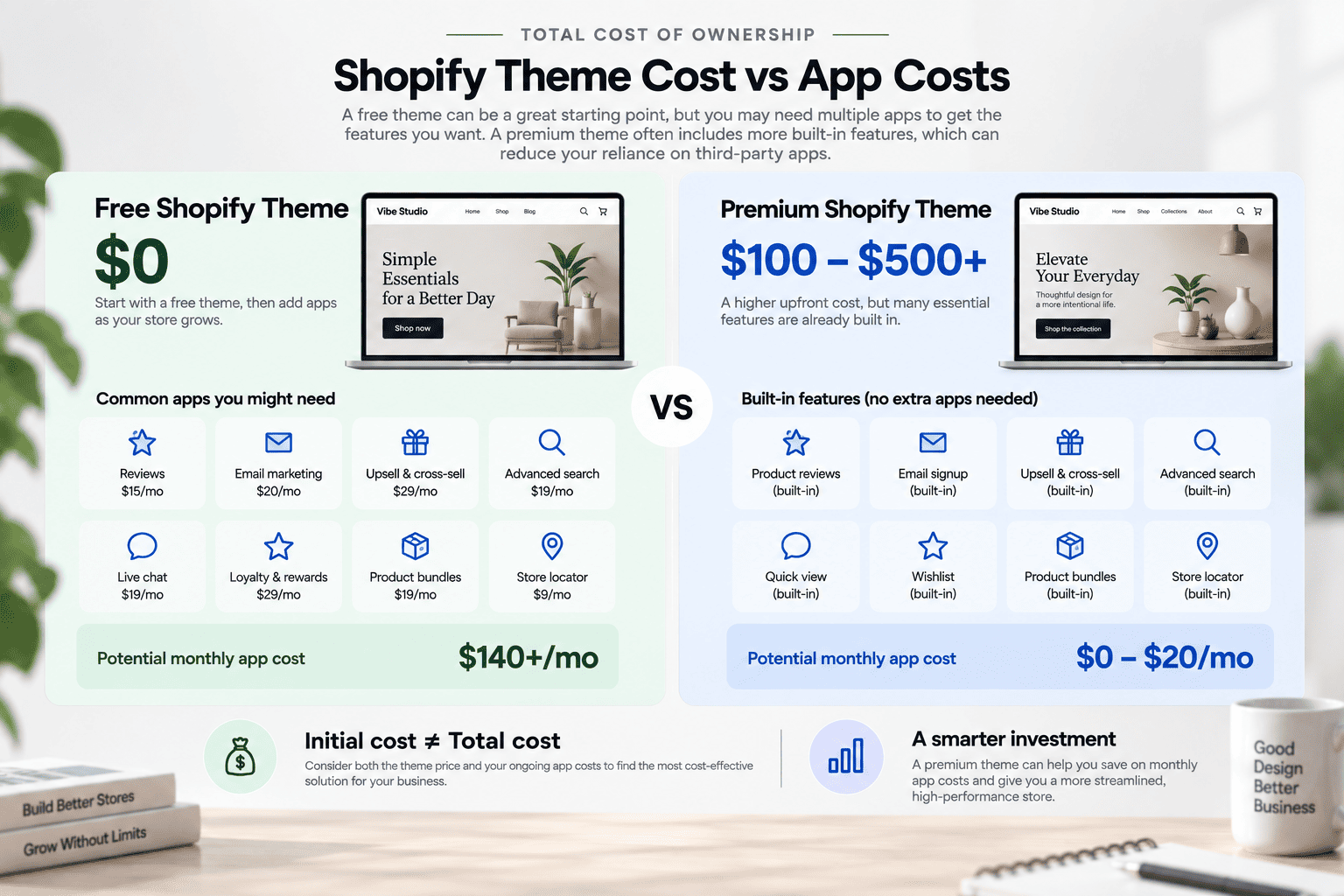
Apps are another important part of the equation.
A theme may cost $300 once, while an app may cost $15, $30, or $50 every month.
Over several years, recurring app costs can exceed the original theme investment.
For example:
$30/month × 36 months = $1,080
That does not mean apps are bad.
Apps can be an excellent way to add functionality quickly without custom development.
But if you are selecting a theme specifically because it includes functionality that you would otherwise need to purchase through multiple apps, that feature set has real financial value.
The right question is not:
“Which theme is cheapest?”
It is:
“Which solution gives me the functionality I need at the lowest reasonable total cost?”
Does a More Expensive Shopify Theme Mean a Better Theme?
Not necessarily.
A $500 theme is not automatically better than a $200 theme.
Theme price can reflect:
- Feature depth
- Design quality
- Developer positioning
- Support
- Market demand
- Development investment
- Target customer segment
But none of these guarantees that the theme is right for your store.
A more expensive theme may contain dozens of features that you will never use.
A less expensive theme may have a cleaner architecture and exactly the functionality your business needs.
Instead of starting with price, start with requirements.
Then compare themes based on those requirements.
How Much Should You Budget for a Shopify Store Theme?
A practical starting point is to think in tiers.
Budget: $0–$150
This range can work well if:
- You are validating an idea
- You have a small catalog
- You can use a free Shopify theme
- You need minimal customization
- You are comfortable doing the setup yourself
A free Shopify theme can be perfectly adequate at this stage.
Growth: $150–$500
This is a useful range for businesses looking for a premium theme with more built-in features and design flexibility.
It can be appropriate when:
- Your brand is becoming established
- Product presentation matters
- You need more advanced layouts
- You want stronger product discovery
- You want to reduce the amount of custom development required
Many current paid Shopify themes fall within this broad range.
Advanced: $500+
At this point, the theme itself may not be the biggest expense.
You may be investing in:
- Custom development
- Advanced integrations
- Specialized functionality
- Performance optimization
- UX improvements
- Custom design
In other words, the project is becoming a store development investment, rather than simply a theme purchase.
What Should You Look for When Comparing Theme Prices?
When comparing two themes, create a feature checklist before looking at the price.
For example:
| Requirement | Theme A | Theme B |
|---|---|---|
| Mega menu | ✓ | ✓ |
| Product filters | ✓ | ✓ |
| Quick view | ✓ | — |
| Color swatches | ✓ | ✓ |
| Custom sections | ✓ | ✓ |
| Cart drawer | — | ✓ |
| Product recommendations | ✓ | ✓ |
| Mobile optimization | ✓ | ✓ |
| Developer support | ✓ | ✓ |
| Price | $250 | $400 |
Now the decision becomes much clearer.
If Theme B costs $150 more but eliminates several development requirements, it may actually be the cheaper solution.
Shopify also allows merchants to preview paid themes and customize the preview before purchasing, which makes it possible to evaluate a theme against your actual products and branding before committing. Shopify currently allows up to 19 paid themes to be previewed simultaneously.
How to Reduce Your Shopify Theme Cost
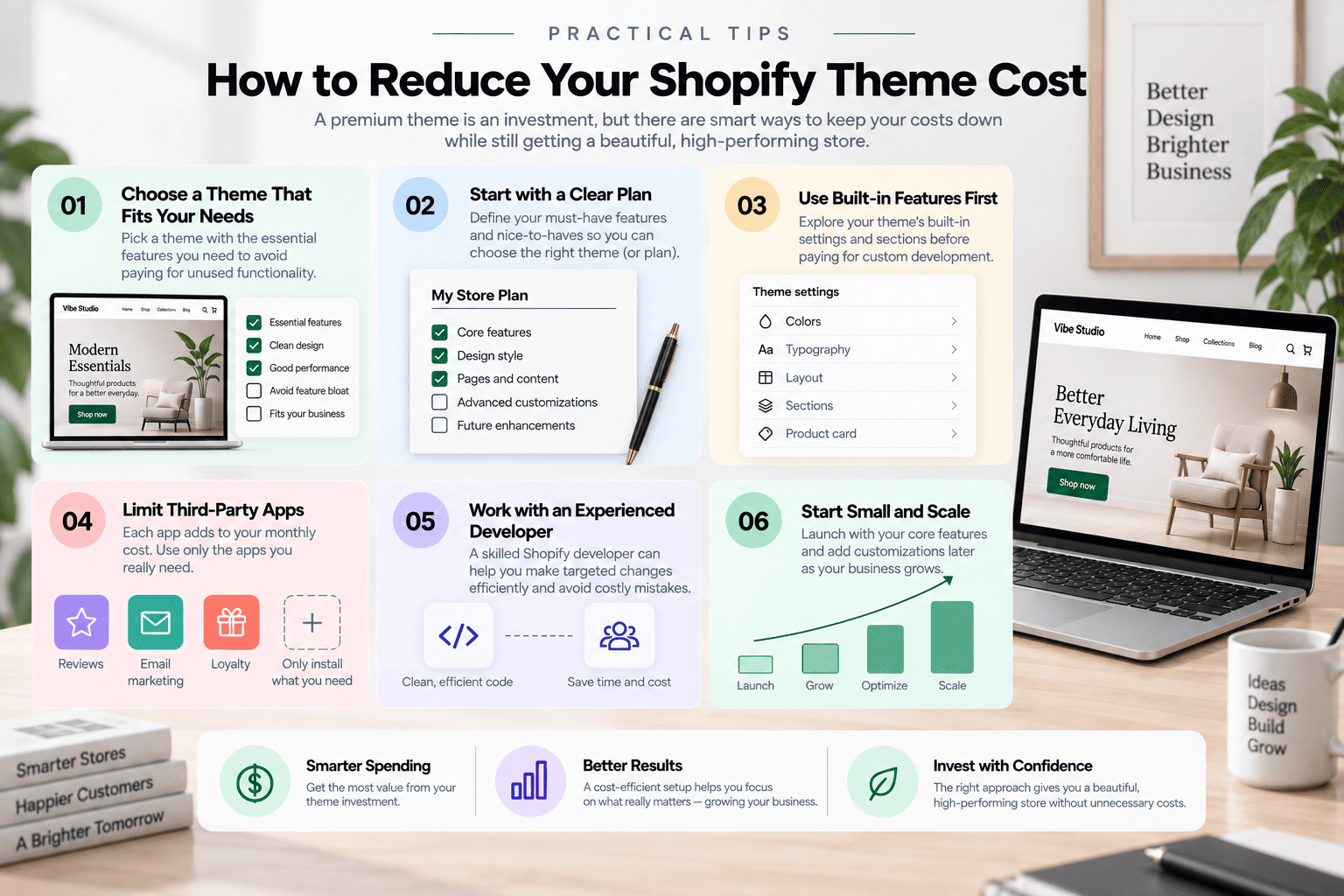
You do not necessarily need the cheapest theme.
You need to avoid unnecessary spending.
Start With a Free Theme
If you are validating your business, start with a free theme and upgrade later if necessary.
Choose Features Before Design
A beautiful theme that lacks critical functionality can become expensive after customization.
Avoid Paying for Features You Will Not Use
More features do not automatically mean more value.
Choose the theme that fits your actual store.
Limit Unnecessary Apps
Before installing an app, check whether the theme already provides similar functionality.
Customize Strategically
Do not rebuild an entire theme simply because you dislike one section.
Targeted customization can often provide the desired result without replacing the whole foundation.
Consider a Premium Theme Before Building From Scratch
If your requirements are mostly standard ecommerce functionality with some unique design or feature requirements, a premium theme plus targeted development may offer a better balance.
When Should You Invest in Custom Shopify Development?
There is a point where theme customization stops being the most efficient solution.
You may want custom Shopify development if:
- Your customer journey is highly specialized
- You need custom business logic
- Your theme requires extensive modifications
- You depend on too many apps
- You need advanced integrations
- Your storefront performance requires significant optimization
- You need functionality that existing themes do not provide
- Your brand requires a highly differentiated shopping experience
In these situations, spending more money on an increasingly expensive theme may not solve the underlying problem.
A better approach may be to use a strong theme foundation and invest the remaining budget in targeted custom development.
Premium Theme + Custom Development: A Practical Middle Ground
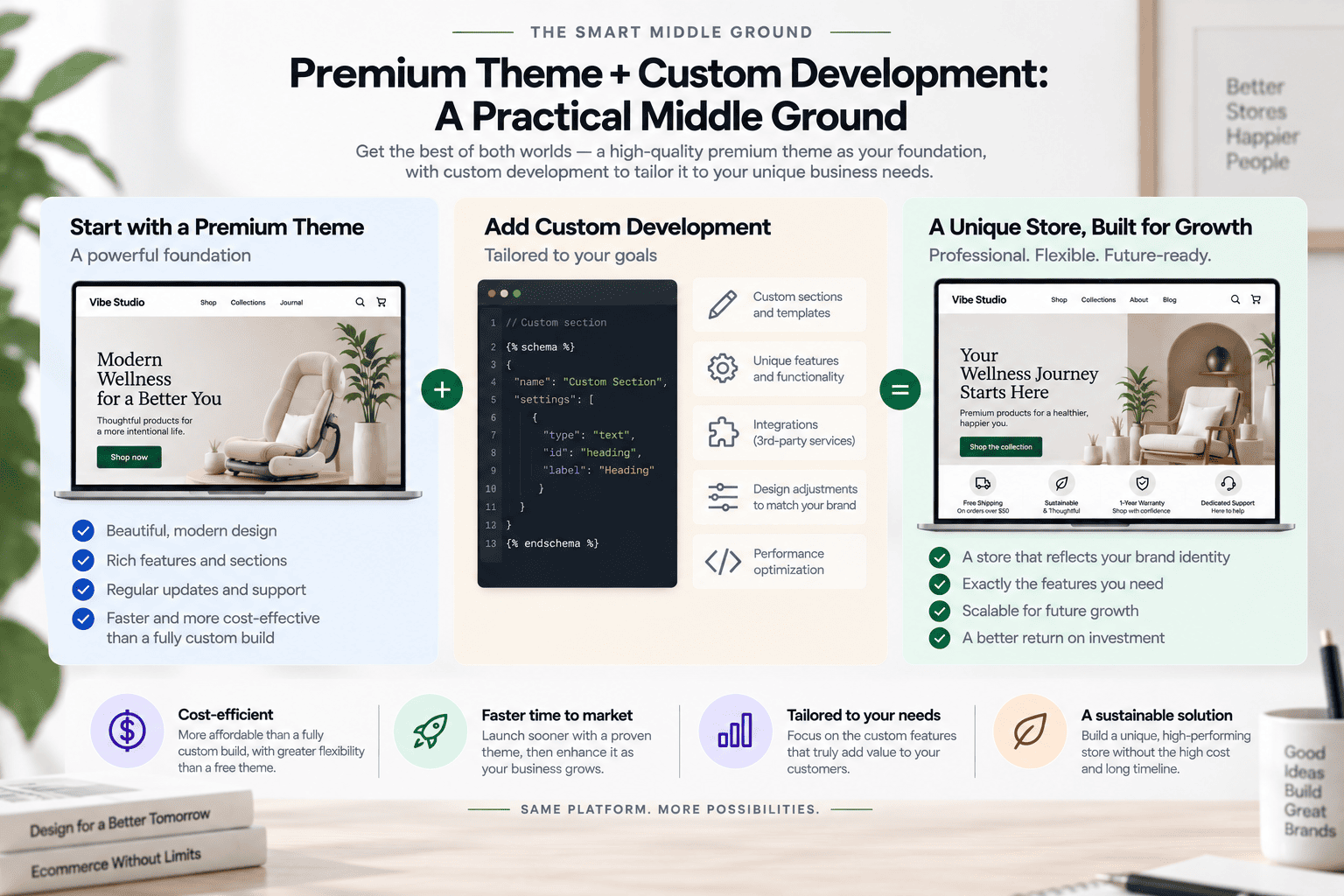
You do not always have to choose between a premium theme and a completely custom Shopify theme.
A hybrid approach can often provide the best balance.
For example:
Premium theme
Provides the storefront foundation.
Custom development
Adds business-specific functionality.
Performance optimization
Ensures the additional functionality is implemented efficiently.
Ongoing improvements
Allow the store to evolve as the business grows.
This approach can reduce development time while still allowing your store to feel and function differently from a standard theme installation.
It is particularly useful for businesses that want to launch relatively quickly but still have requirements that go beyond the default theme experience.
How Much Does a Shopify Theme Cost in the Long Run?
The initial theme price is only the beginning.
A realistic long-term budget may include:
Theme
$0–$500+
Shopify subscription
Recurring platform cost
Apps
Potential recurring monthly costs
Customization
One-time or ongoing development
Design
Branding, UX, graphics, photography, and content
Maintenance
Updates, improvements, bug fixes, and technical work
SEO and performance
Ongoing optimization and content work
This is why a $300 theme can be an excellent investment for one store and a poor investment for another.
The value comes from how effectively the theme supports the business.
Is a Shopify Theme Worth Paying For?
For many stores, yes.
A premium theme can save development time, provide a more polished shopping experience, and include functionality that would otherwise require custom development or additional apps.
But paying for a theme does not automatically make your store better.
The theme still needs to:
- Match your brand
- Support your products
- Work well on mobile
- Provide the features your customers need
- Perform efficiently
- Receive ongoing updates
- Fit your future growth plans
Shopify notes that paid themes are developed by third-party theme developers, with general support and updates provided by those developers.
You should therefore evaluate the developer as carefully as you evaluate the theme itself.
What About Shopify Theme Licensing?
Licensing is another cost consideration that is easy to overlook.
When you purchase a theme through the Shopify Theme Store, the license is tied to the store where the theme was purchased. You cannot simply purchase one theme license and use it across multiple independent stores.
For Shopify Plus organizations, Shopify also states that separate theme licenses are required for each expansion store using the theme.
This matters if you operate:
- Multiple storefronts
- Regional stores
- Expansion stores
- Separate brands
- Multiple Shopify Plus storefronts
Always check the current licensing terms before planning a multi-store implementation.
Common Mistakes When Budgeting for a Shopify Theme
Choosing the Cheapest Theme
Price should be one factor, not the deciding factor.
Looking Only at the Theme Price
Remember to account for apps, customization, development, and other store costs.
Paying for Features You Do Not Need
A long feature list does not necessarily create a better store.
Ignoring Performance
A visually impressive theme can still create a poor customer experience if it is overloaded with unnecessary code or third-party functionality.
Forgetting Future Growth
A theme that works for 20 products may not be ideal for a catalog of 2,000 products.
Assuming Custom Development Is Always More Expensive
Sometimes targeted custom development is cheaper than repeatedly modifying a theme or maintaining several apps.
The right solution depends on the scope.
Shopify Theme Cost: What Should You Actually Spend?
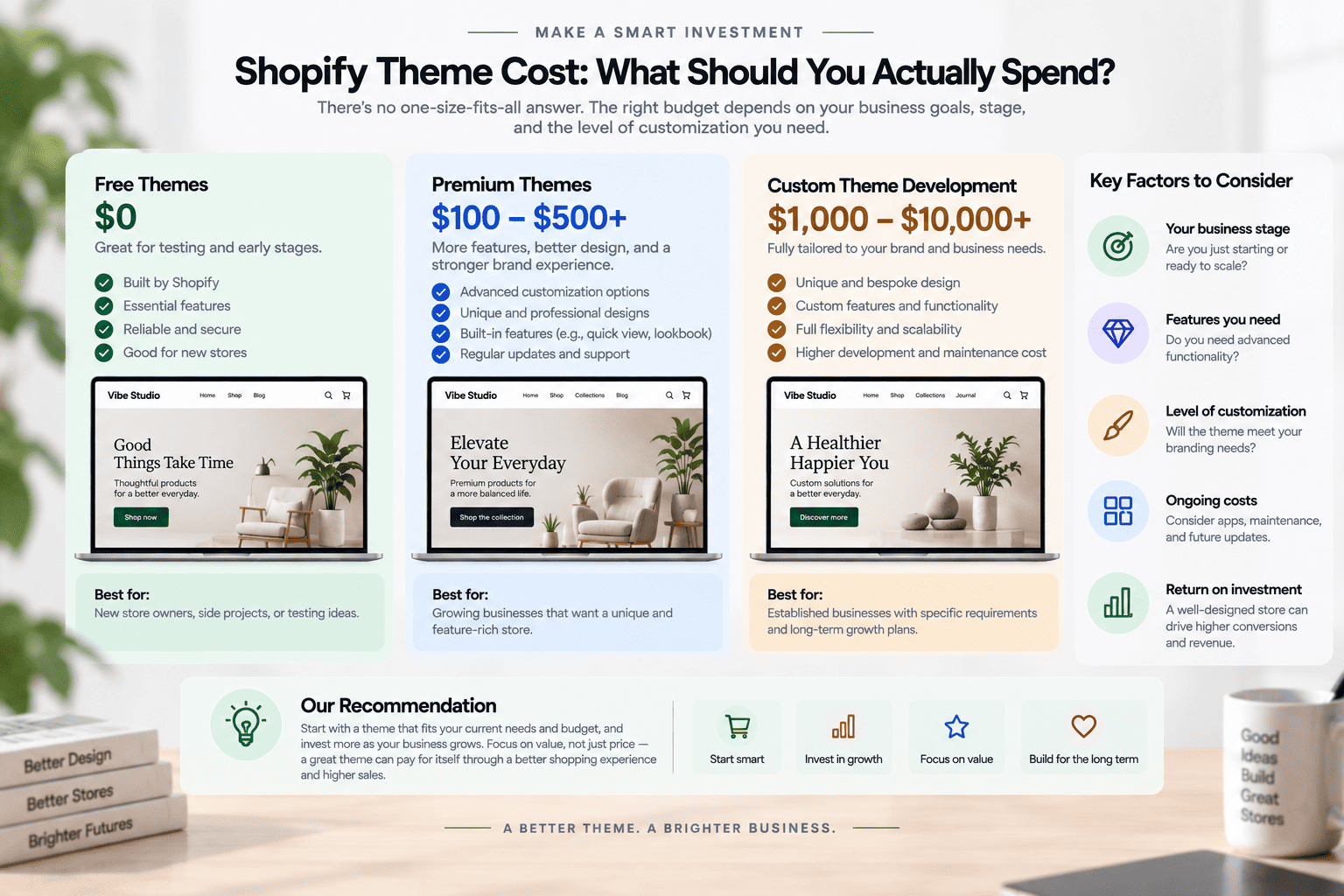
There is no universal number that every Shopify merchant should spend on a theme.
For a new store testing an idea, $0 may be the smartest starting point.
A growing brand may benefit from spending $150–$500+ on a premium theme, especially when it needs more features and design flexibility.
When a business has specialized requirements, the theme price may become a relatively small part of the overall investment. Custom development, integrations, UX, and performance work may matter much more.
The key is to spend according to the problem you are trying to solve.
Final Thoughts
The cost of a Shopify theme can range from free to several hundred dollars, but the cheapest theme is not always the cheapest solution.
A free theme can be an excellent choice for a new or straightforward store. A premium Shopify theme can provide more design flexibility and built-in functionality for a growing brand. And when your requirements become highly specific, custom Shopify development may provide better long-term value than continually modifying an existing theme.
The best approach is to evaluate the total cost of ownership, not just the price displayed on the Theme Store.
Choose the theme that gives your business the right combination of design, functionality, performance, support, and room to grow.
The goal is not to spend less on your theme. The goal is to spend wisely on the foundation of your store.
If you are unsure whether a free theme, premium theme, or custom Shopify development is the right investment for your store: